
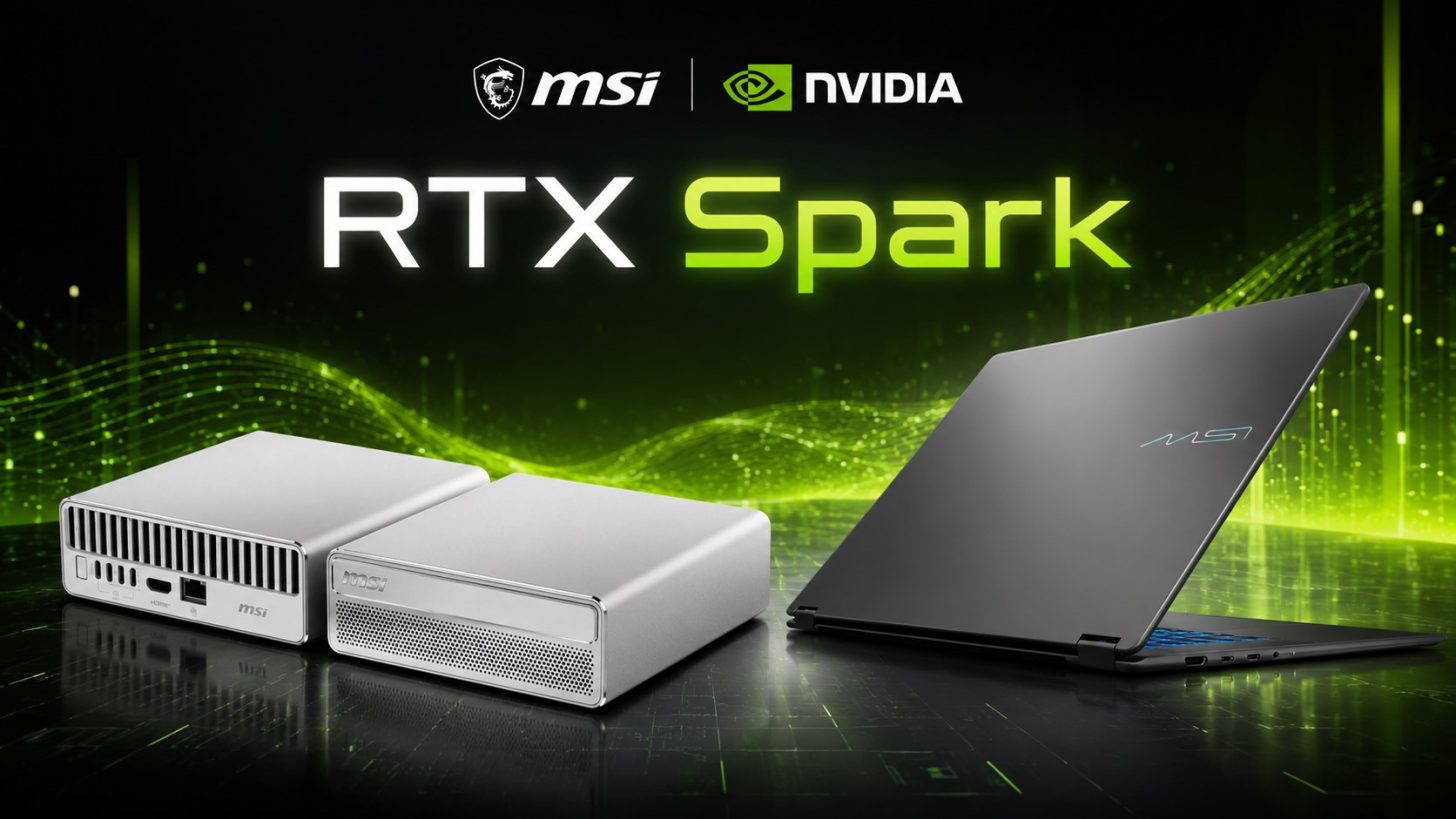
NVIDIA’s RTX Spark mini PCs introduction at Computex 2026, with ASUS, Dell, Lenovo, and MSI displaying compact AI-powered desktops. Featuring unified memory, powerful GPUs, and edge AI capabilities, these systems could redefine the future of desktop computing.
Computex Taipei 2026 was brimming with announcements, but few drew as much attention as NVIDIA’s RTX Spark platform. For the first time, NVIDIA is stepping directly into the PC processor market, and the debut of Spark powered mini PCs from ASUS, Dell, Lenovo, and MSI suggests a major change in how we think about desktops. Compact, AI focused, and enhanced with unified memory, these systems are being positioned not just as alternatives to traditional towers, but as the future of local AI computing.
NVIDIA’s Bold Entry Into PC Processors
The RTX Spark platform is built on an Arm-based system-on-chip (SoC) that fuses NVIDIA’s Grace CPU with its Blackwell GPU.
The configuration includes a 20-core CPU and a GPU with 48 streaming multiprocessors and 6,144 CUDA cores.
It supports up to 128GB of LPDDR5X unified memory, a design that allows CPU and GPU to share resources seamlessly.
NVIDIA says Spark is optimized for local AI development, content creation, gaming, and inference workloads.
Graphics performance is claimed to be comparable to an RTX 5070 class GPU in certain scenarios, putting it squarely in the mid-to-high range of consumer graphics while offering specialized AI acceleration.
Mini PCs Take the Stage
At Computex, several manufacturers unveiled their own takes on Spark-powered mini PCs:
- ASUS ProArt GA10: A compact 150 × 150 × 51 mm design with up to 140W cooling capacity, four USB-C ports, HDMI output, and 10GbE networking.
- Dell XPS RTX Spark Desktop: A small-footprint system with similar connectivity, aimed at professionals who want power without bulk.
- Lenovo RTX Spark Mini PC: A newly designed chassis built around Spark, offering the same connectivity suite.
- MSI EdgeMesa N AI+: A standout with a sleek white chassis, targeting creators and AI developers.
All models share common features: 10GbE networking, 20Gbps USB-C connectivity, PCIe Gen 5 M.2 SSD support, and up to 128GB unified memory.
These specs suggest a new baseline for compact desktops, where high-bandwidth connectivity and massive memory capacities are no longer reserved for full-sized towers.
MSI’s EdgeMesa N AI+: The Flagship Spark System
Among the Spark systems, MSI’s EdgeMesa N AI+ has emerged as a flagship. Unlike other vendors, MSI confirmed it is using NVIDIA’s most powerful Spark configuration, the N1X SoC. This chip combines the 20-core Grace CPU with the Blackwell GPU and supports up to 128GB of LPDDR5X memory. Storage options include a single NVMe SSD slot with support for up to 4TB.
MSI claims the EdgeMesa N AI+ can deliver up to 1 petaFLOP FP4 of AI performance, a staggering figure that positions the mini PC as a serious contender for local AI workloads. That level of compute power makes it suitable for training and running large language models, generative AI applications, and real-time inference tasks that traditionally required cloud infrastructure.
Connectivity is equally robust. The EdgeMesa N AI+ includes four USB-C ports (three supporting DisplayPort Alt 1.4, one with Power Delivery), HDMI 2.1b, 10GbE LAN, WiFi 7, and Bluetooth 5.4.
Display support extends to four monitors simultaneously, making it versatile for development workstations, control centers, or creative studios.
Targeting AI at the Edge
MSI has positioned the EdgeMesa N AI+ as more than just a consumer device. The company sees applications across industries such as healthcare, finance, retail, robotics, manufacturing, and smart cities. These sectors often require rapid processing of large datasets while maintaining strict privacy and compliance standards. By enabling local AI processing, the EdgeMesa N AI+ reduces reliance on cloud services, lowers latency, and improves data security.
This reflects a broader industry trend: AI workloads are moving closer to the edge. Instead of sending sensitive data to centralized servers, organizations are increasingly deploying compact, high-performance systems that can process information locally. NVIDIA’s Spark platform, with its unified memory and AI-focused design, appears tailor-made for this shift.
Why Spark Could Be a Game Changer
For consumers, Spark-powered mini PCs promise desktop-class performance in a fraction of the space. The integration of CPU, GPU, and unified memory on a single platform could simplify workflows for creators, developers, and even gamers. Editing high-resolution video, running advanced AI models, or handling demanding workloads locally becomes feasible without heavy reliance on cloud infrastructure.
For enterprises, Spark systems offer scalability and manageability. With 10GbE networking and support for multiple displays, they can slot into existing IT environments while delivering specialized AI capabilities. The inclusion of a full-stack AI software ecosystem further streamlines deployment.
The trade-off, however, lies in compatibility. Some older Windows applications and specialized software may face challenges on Arm-based systems. While Windows on Arm has improved significantly, it remains to be seen how seamless the transition will be for businesses with legacy software.
The Road Ahead
Pricing and availability details for Spark systems remain under wraps, though MSI and other vendors are expected to release more information later this year. What’s clear is that NVIDIA’s entry into the PC processor market has already shaken up the landscape. For decades, Intel and AMD have dominated desktop CPUs, but Spark introduces a new competitor with a distinctly AI-first approach.
If NVIDIA’s performance claims hold true, Spark mini PCs could redefine what users expect from desktops. Compact, powerful, and designed for AI, they represent a convergence of consumer and enterprise needs at a time when artificial intelligence is becoming central to both.
Conclusion
The debut of NVIDIA’s RTX Spark platform at Computex 2026 marks a turning point in desktop computing. By fusing CPU, GPU, and unified memory into a single AI-focused architecture, NVIDIA has created a foundation for compact systems that can rival traditional desktops. With manufacturers like ASUS, Dell, Lenovo, and MSI already on board and MSI’s EdgeMesa N AI+ showcasing the platform’s full potential, Spark mini PCs are poised to become the new standard for AI-driven computing.
Whether they will fully replace traditional desktops remains to be seen, but one thing is certain: the desktop PC is evolving, and NVIDIA’s Spark is leading the charge.
Leave a Reply